
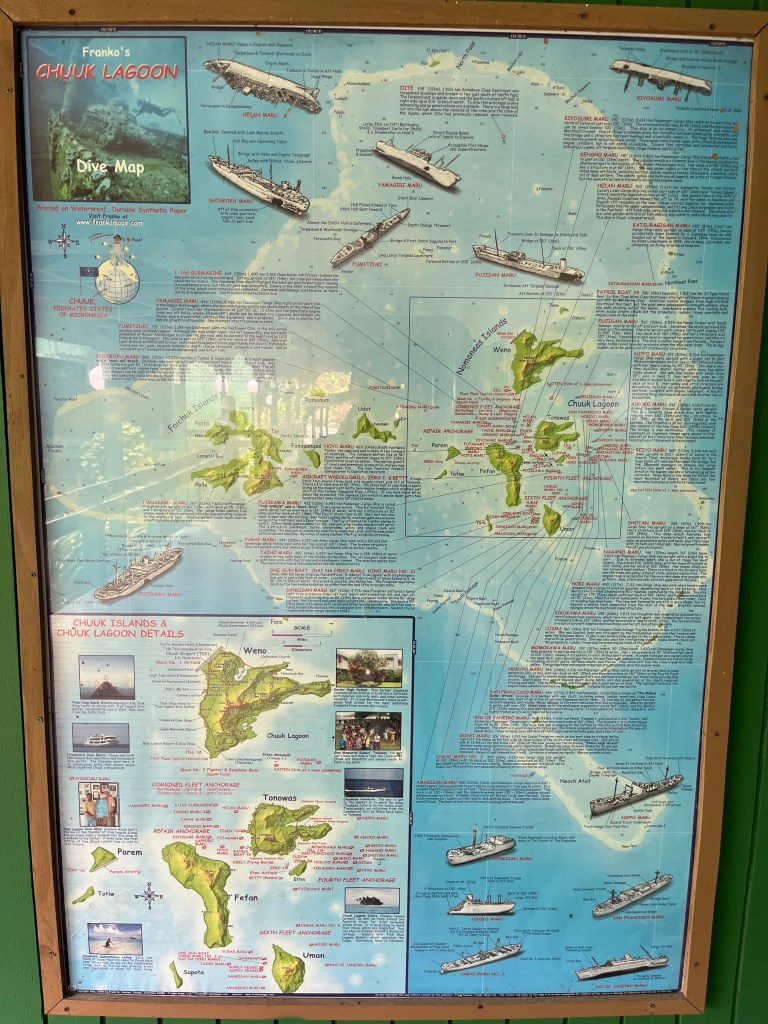
Our second country stop was in Chuuk, a state within the Federated States of Micronesia. Chuuk lagoon was a significant location during WWII because it was the main Japanese naval base in the south pacific until the Americans sunk a large portion of the Japanese surface fleet there during Operation Hailstone in February 1944. Some say it was payback for the Japanese attack on Pearl Harbor. During the 2-day battle 51 Japanese ships were sunk and 500 aircraft were destroyed. There were naturally some American planes shot down during the battle as well and they were lost to the deep. Even now, some 81 years later, casualties are still being found and recovered from downed aircraft there. Earlier this year 3 Americans were discovered in 2 downed planes in the lagoon, 1 of which was just off the port side of where the USS Pearl Harbor was docked in Chuuk during our country stop. Operation Recover, a group devoted to searching for and bringing home American MIAs and POWs typically performs a simple flag ceremony at the site of found remains and that flag is then delivered to the family of the deceased along with the service member’s remains in an attempt to help bring closure for the family and honor their ultimate sacrifice. The flag ceremony had not yet been completed for those of the site just off the port side of our ship. In true partnership, Operation Recover was able to host this ceremony on the flight deck of the USS Pearl Harbor with Pacific Partnership and the ship’s crew in attendance. 3 flags from our ship were folded in honor of each of the 3 MIAs, and a member of the Pacific Partnership band played taps on the trumpet. It was a very touching ceremony full of history and meaning, and I was honored to be in attendance.
On a lighter note, and the flip side of all these ships and planes being sunk, it makes for some incredible SCUBA diving! When I was not working, I took the opportunity to dive these massive historical wrecks. Prior to this mission I had some knowledge of Chuuk lagoon as a destination dive location, someplace on many avid divers’ bucket lists. But I didn’t think that I would ever make it there, and yet I have now joined the ranks of those who have experienced the marvels of Chuuk lagoon in person. The ships still hold fighter airplanes, tanks, trucks, guns, bottles of alcohol, and various personal effects in their cargo holds just as the day they were sunk. On one of the ships the Engine Order Telegraph system even still moves. I also dove a downed bomber that the front broke off of and is lying to the side of the fuselage, so it is possible to swim from the front of the plane down through the fuselage and exit out the tail of the plane. Due to the amount of aluminum alloy used in the manufacturing of the bomber, it is in surprisingly good shape even some 80 years after crashing into the ocean.
Like many small pacific islands, Chuuk is resource-constrained, and it showed. Vehicles are imported from elsewhere, largely Japan and other Asian countries for use on the island. The locals keep them running as long as possible, sometimes harvesting parts off of other broken-down vehicles. Then when they significantly break down, they just leave them on the side of the road where they quit. There they sit abandoned and in various states of disrepair as a source of still-useful parts. Every 10 years a non-profit organization comes through and clears out all the cars from the island to recycle them. I am not sure where we are in that 10-year cycle, but there were numerous junk vehicles along the roadways as we drove around the island.
Despite their limited resources, the local people we met were friendly and accommodating to us. They welcomed us to participate in their hospital, guest lecture at their community college, and attended our classes and engagements. Although I do think we quickly overwhelmed their restaurants with the 500 people the mission brought to their island. As the time we were there progressed, the menu at the closest restaurant to the ship became smaller and smaller as they ran out of required ingredients.
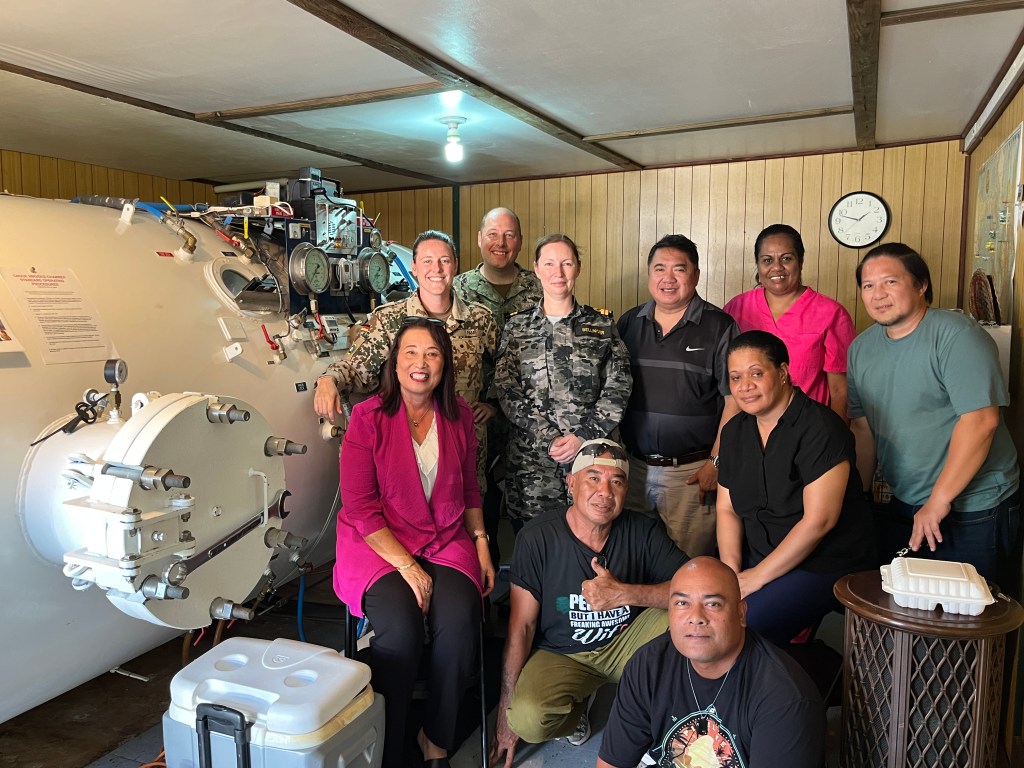
During our time on island I was a guest instructor at the local college, helped present at the Dive Medicine Symposium, toured their compression chamber and assisted behind the scenes to ensure all our engagements ran smoothly and people were shuttled to where they needed to go. I also manned a booth about Disaster Management for Families at our Community Health Engagement event.

 The Ready Rovers