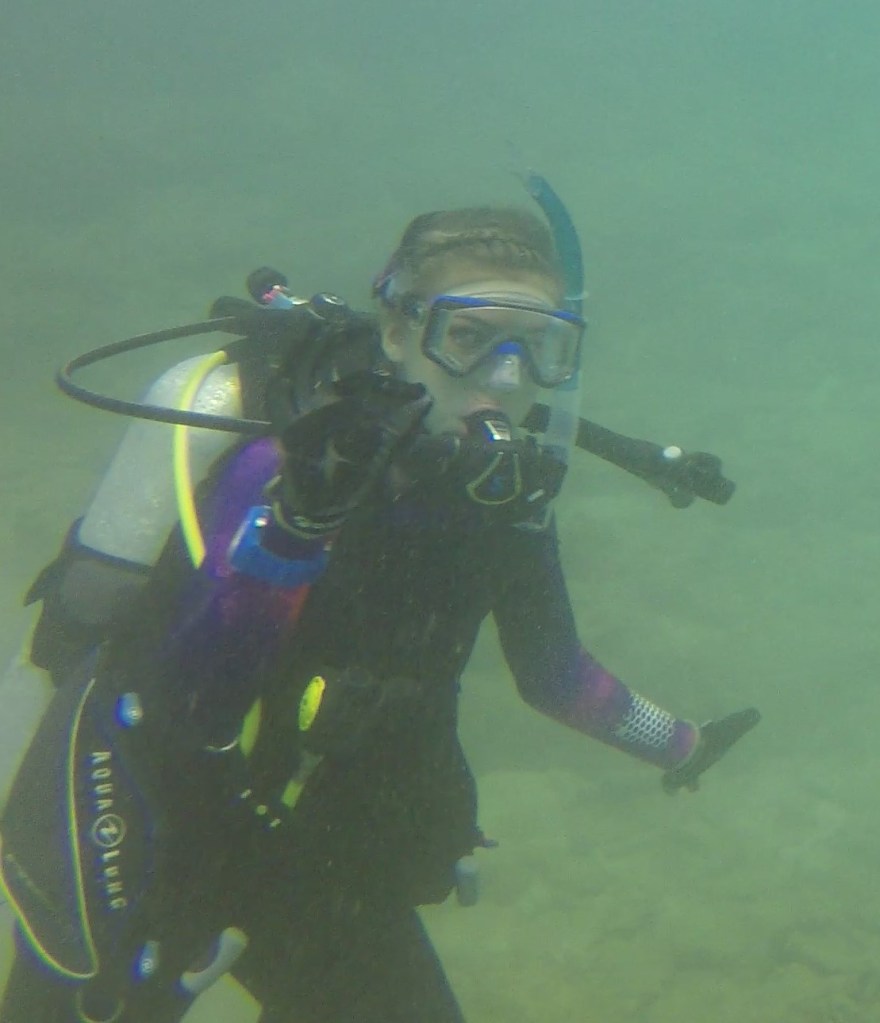
It’s Getting Technical

(Photo credit to Negkafou_Photography)

by Kevin

When I was stationed in San Diego a number of my peers took their Open Water scuba certification class. I was invited to join them, and I would have loved to go, but with Heather 39 weeks pregnant with Chipmunk, I decided against it. After arriving on Okinawa I was again presented the opportunity to take an Open Water scuba class. This time I was able to do it, and became certified as an Open Water diver, the lowest level of PADI certification. Open Water divers are certified to dive to a depth of 60 feet. I really enjoyed exploring this new underwater world and continued diving and exploring around the coasts of Okinawa. Once I had about 25 dives under my belt I made the next step in certification and took my Advanced Open Water class as well as the Deep Diver class. With Advanced Open Water I could now dive to a depth of 100 feet below the surface. Upon completing the Deep Diver class I was able to dive to the recreational diver limit of 130 feet below the surface. As an Open Water diver in the clear Okinawa water one can look up and see the sun and the surface and maybe even some waves on the surface. Once one dives down to about 100 feet you tend to lose sight of the surface and it is just a brighter shade of blue when you look up. This can be a little unnerving for some as they realize that if they have some issue it may be more difficult to simply pop to the surface to breath atmospheric air. At 130 feet the NDL (No Decompression Limit) is also pretty short, so I could only stay at that depth for about 10 minutes or less before I needed to ascend to a shallower depth. Exceeding the NDL requires a diver to make stops along their ascent to wait for a certain amount of time before ascending further. These stops allow the diver’s body to decompress, aka release dissolved nitrogen from their tissues and blood stream to prevent an air embolism, or bubble, from forming in their tissues or vessels. These bubbles can be very painful and can lead to altered blood flow to the brain or heart. In the worst case these bubbles can result in death, so respecting the NDL is very important as a recreational diver.

One of the dive sites along the Okinawa coast is the wreck of the USS Emmons, a World War 2 battleship that was intentionally sunk by the US Navy after it had been disabled to prevent it from falling into Japanese hands. This wreck sits on the ocean floor with a depth of 142 feet at the sand. The most shallow part of the ship sits at about 118 feet below the surface, so the wreck is deep and at the fringe of the recreational limit. This certainly limits the amount of time a diver can spend exploring the wreck. I had the privilege of diving the wreck, but knew I wanted to spend longer down on the wreck. Enter technical diving.

Technical diving allows divers to intentionally and safely exceed the NDL through proper planning, preparation, and training. Technical divers typically carry larger volumes of compressed gasses, redundant breathing systems, as well as extra tanks of mixed gasses with higher percentages of oxygen (up to 100%) to speed up the decompression process as they ascend. Technical divers pre-plan their dives and then dive that plan. This ensures they have enough breathing gas to safely complete the dive and have a reserve to use in case of emergency. I went through my technical diving class with a friend/coworker and we practiced many skills with each other underwater along the way. At the completion of technical diver training I am now certified to dive to a depth of 170 feet for as long as I feel like carrying appropriate volumes of breathing gasses with 21% oxygen or more. At 170 feet the water becomes this eerie twilight world and diving flashlights are recommended. With technical diving skills and certification in hand I was able to dive the USS Emmons again using a technical gear configuration and was able to spend about 35 minutes exploring the wreck instead of 10 minutes as a recreational diver, which was a huge difference! Additionally, because all the recreational divers had to head for the surface pretty quickly, I was able to spend the majority of the dive exploring the wreck with no other divers around except my buddy. I have truly enjoyed the added depth and length of dives available to me. As I descend popular dive sites with lots of corals I frequently see many broken pieces of coral between the surface and 60 feet, the range where the most divers are certified. Between 60 and 130 feet  I see a little less coral destruction as there are fewer divers certified to those depths, and as I pass below 130 feet the coral appears virtually untouched. It is at these deeper depths that I find the most enjoyment as I explore a landscape largely untouched by human hands and frequented by few. While technical diving is not for everyone, if you are a diver and consistently find your dives (especially deeper dives) being limited by your NDL, technical diving may be a new way to broaden your diving adventures.

Note: For anyone that is wondering, there are additional technical dive classes available beyond what I am certified for that introduce tri-mix (a mix of oxygen, nitrogen, and helium) with some mixes containing less than 21% oxygen which are suitable for the increased water pressures below 170 feet.

Underwater Pumpkin Carving

By Kevin

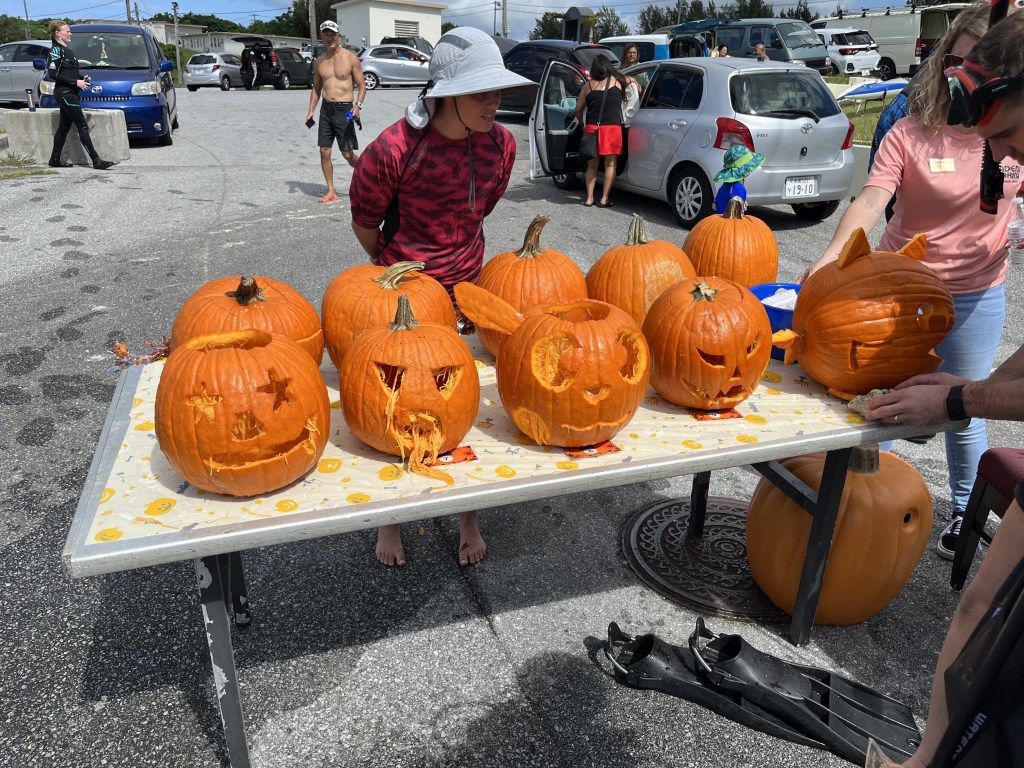
Since arriving in Okinawa, Japan I have been able to complete scuba diver certification, and enjoying the underwater world so much, I have also encouraged Heather, Pie, and Bug to become certified as well. These certifications have opened up a whole new world of experiences and opportunities for us. One of which has been underwater pumpkin carving. On a sunny Saturday in October Bug and I met the other 9 teams at Kadena Marina to compete. Once the first timer started we were able to cut a lid, remove the seeds from inside the pumpkin, and use a grease pencil to mark our design on the outside of the pumpkin. We were then issued an ice pick and a butter knife to complete our pumpkin. We geared up in our scuba kit, made our way to the water and descended to about 12 feet below the surface where we had 30 minutes to complete our pumpkin carving. This, of course, added some new degrees of difficulty. We had to keep a hold of the pumpkin to keep it from floating up to the surface, we had fish swimming through feasting on the discarded chunks of pumpkin, and we each had a scuba regulator in our mouth, so we could not speak to each other. We had to use hand signals and gestures to coordinate our carving efforts. The judges swam back and forth checking on the teams to ensure we were not cheating by adding extra dive weights to our pumpkin to keep it on the bottom, by using un-approved carving tools such as dive knives, or any other unfair advantages we may have thought up. At the conclusion of the 30-minute time limit we surfaced and made our way back to the beach. Our pumpkins were displayed and judged, and while we did not take home the trophy, it was an enjoyable unique event that many of Bug’s peers have not had the opportunity in which to participate.

Kerama Islands Dive Trip

The Kerama Islands are a cluster of small islands 32 kilometers southwest of Okinawa, Japan. Most of these small islands are uninhabited, yet offer a beautiful backdrop for boat trips to the crystal clear waters around them. While I have been able to dive quite frequently around Okinawa, sometimes accompanied by Heather, Pie, or Bug, I rarely get to dive with all of them at once since someone typically has to stay back to keep an eye on Miss Kicky Feet and Chipmunk while the others go diving. On this occasion, however, we were able to arrange alternate care for the little two and the four of us departed on a dive boat for the day to the small island chain. It did not disappoint! At the first location that we stopped to dive, I looked over the side of the boat and could see the bottom clearly. It looked as if we were in maybe 10 feet of water or less when in reality it was closer to 50 feet deep. We geared up and dropped into the water to explore the area. The reef was healthy, vibrant in color, and alive with fish and turtles. We spent almost an hour exploring before returning to the boat to head on to our next dive location. The second site was a little bit deeper than the first, but still just as clear. From the bottom we could look up and see the hull of our dive boat bobbing above us with perfect clarity. After exploring this site for about an hour we surfaced and boarded the boat. Since we had been under the boat during the beginning and end of our dive, we knew there were no hazards below the boat. With our Divemaster’s permission Bug proceeded to leap from the second deck of the dive boat into the water. Since he was still wearing his wetsuit but had shed his lead weights and other dive gear, once he jumped in, he popped right back up to the surface due to the extra buoyancy of his wetsuit. Of course Pie then decided she needed to try this too. After watching their two successful jumps pretty much everyone else on the chartered boat decided they too needed to experience the thrill of jumping from the upper deck into the water. This went on for probably 20 minutes or so before the captain decided it had gone on long enough and that the time had come to return to the dock on Okinawa. I really enjoyed being able to dive with Heather and two of my children, and the memory of leaping from the second deck of the dive boat will stick with us for quite a while. On the return trip the weather took a turn for the worse, which is always a possibility on a sub-tropical island. The waves grew in size, the wind picked up, and the sky turned darker. One of the other divers was sitting at the back of the boat fanning herself and trying to hold her nausea at bay. Pie, on the other hand, was not sea-sick at all and was actually leaning off the side of the boat with her head in the wind loving life much like a dog hangs its head out the car window into the wind. The stark difference between the other diver and Pie made me chuckle.

Adding Another Bubble Maker

By: Kevin

When we arrived in Okinawa last year we were told there is world-class scuba diving here. We also were educated about all the aquatic life that could injure us in the waters around Okinawa. It took us a few months to determine the true safety of the water, but once we made it past that, we have been exploring the water ever since. I, Kevin, got scuba certified in September of last year, and Heather followed suit in October. Well, now we have a third diver in the family, Pie. Pie successfully passed her Open Water scuba certification this month!

Heather and I have really been enjoying exploring the many colors of the reef, the fish and other aquatic life that live here, and the adventure of being 60 feet under the waves, an area previously inaccessible to us. We have found fouled anchors that had to be cut free from whatever vessel they previously held, discarded sections of large pipe, a Japan Post mailbox, and even a Tiki man carved into the side of a reef that supports a river channel marker. We knew that if we passed up the opportunity to allow the kids to become certified we, and they, would most likely regret it.

Japan Post Mailbox (40′ underwater)

Pie did very well in her class, even showing up her adult classmates in book knowledge and completed her pool and ocean dives successfully. Pie’s instructor was kind and patient and even allowed me to tag along for fun as Pie completed her class ocean dives. I cannot wait to be able to explore the waters with her and see her reactions to the things we find underwater. In the near future, once he finishes with his soccer season, Bug is excited to start his training for scuba diving as well.